


Deepfakes and Digital Wellbeing: When Artificial Intelligence Blurs Reality
September 14, 2026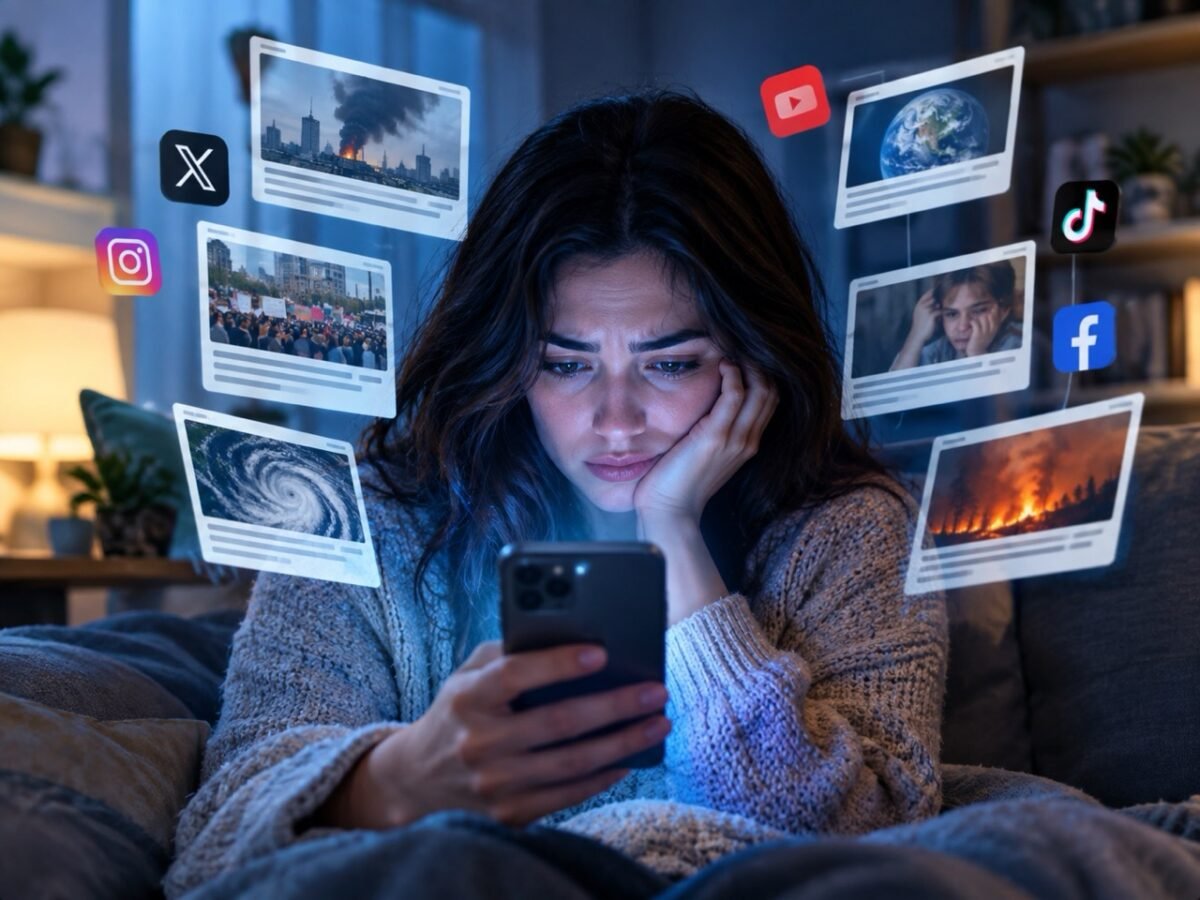
You pick up your phone to check one piece of news.
Five minutes later, you are reading about another crisis. Then another. You move from a news website to social media, from one post to another, and somehow 40 minutes have disappeared.
You know the experience is making you feel worse, but you keep scrolling.
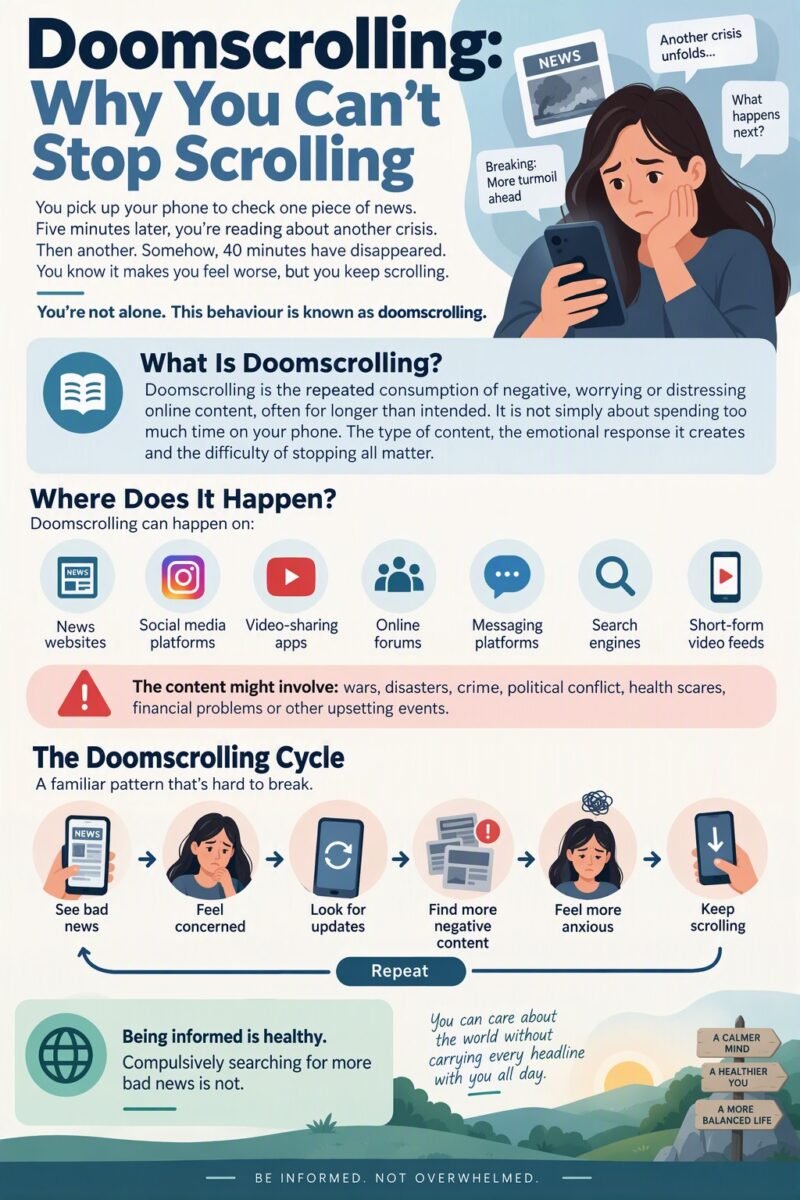
This behaviour has become known as doomscrolling: repeatedly consuming large amounts of negative or distressing information online, often for longer than intended.
Doomscrolling is not simply about spending too much time on your phone. The type of content, the emotional response it creates and the difficulty of stopping all matter.
Research on doomscrolling is still developing, and the term itself is not a formal medical diagnosis. However, studies have found associations between problematic consumption of negative news and outcomes such as anxiety and poorer mental wellbeing. A 2024 cross-cultural study involving university students in Iran and the United States, for example, found an association between doomscrolling and existential anxiety.
So why do we keep looking at information that makes us uncomfortable?
And, more importantly, how can we break the cycle without disconnecting completely from the world?
What Is Doomscrolling?
Doomscrolling describes a pattern of continued consumption of predominantly negative, worrying or distressing online content, even when the person recognises that the behaviour is unpleasant or unhelpful.
It can happen on:
- News websites
- Social media platforms
- Video-sharing apps
- Online forums
- Messaging platforms
- Search engines
- Short-form video feeds
The content might involve wars, disasters, crime, political conflict, health scares, financial problems or other upsetting events.
The important feature is not simply that the news is negative. Sometimes staying informed about difficult events is sensible and necessary.
The problem is the repetitive and difficult-to-control pattern.
For example, there is a difference between spending 15 minutes reading reliable information about an important event and spending two hours jumping between increasingly alarming posts without gaining much useful information.
Doomscrolling can also involve repeatedly checking for updates even when nothing new is likely to have appeared.
Why Is Doomscrolling So Difficult to Stop?
There is no single reason why people doomscroll. Several psychological and technological factors can work together.
1. Negative information captures our attention
Humans naturally pay attention to threats and potential dangers.
From an evolutionary perspective, noticing something potentially dangerous can be useful. In the digital environment, however, there can be an almost unlimited supply of information designed to capture attention.
A serious headline can feel more urgent than a positive or ordinary story.
The result is an environment where your attention can repeatedly move towards whatever seems most alarming.
2. We want to know what happens next
Uncertainty can be uncomfortable.
Imagine seeing a headline about a major event but not knowing what happened afterwards. You may tell yourself:
“I’ll just check for an update.”
Then another update appears.
Then another.
The feeling that there may be important information just one scroll away can encourage continued checking.
This is one reason doomscrolling can feel different from deliberately reading a newspaper article. Instead of reaching a natural stopping point, an endless feed keeps providing another piece of content.
3. Social media makes the information stream continuous
Traditional news has natural boundaries. You might read an article, finish a newspaper section or watch a scheduled news programme.
Many digital platforms have no obvious ending.
You can continue scrolling indefinitely.
Each new item provides another opportunity to engage, while algorithms can personalise feeds based on previous interactions.
This does not mean that every recommendation algorithm deliberately tries to make people anxious. Rather, digital platforms are designed around continuous content discovery, which can make stopping more difficult.
4. We may confuse more information with more control
When something frightening happens, searching for information can create a temporary feeling of control.
You might think:
“If I understand everything that’s happening, I’ll know how to respond.”
But there is a point at which additional information stops being useful.
Reading another 30 posts may not provide 30 times more understanding. It may simply expose you to more speculation, conflicting opinions and emotionally charged content.
Doomscrolling and Digital Wellbeing
Digital wellbeing is not about avoiding technology.
It is about developing a relationship with technology that supports your goals, health and everyday life.
That distinction matters.
You do not necessarily need to stop reading news, delete social media or avoid difficult subjects.
Instead, ask:
Is my digital behaviour helping me understand what matters, or am I continuing because I cannot stop?
Research on problematic digital technology use suggests that reducing problematic patterns is possible, although the evidence varies considerably between behaviours and interventions. Recent reviews have found promising results from psychological, educational and other structured approaches, while also highlighting the need for stronger research.
Signs That You May Be Doomscrolling
Everyone occasionally spends too long online. That does not automatically mean you have a serious problem.
However, you may want to reconsider your habits if you regularly:
- Open your phone intending to check one update but remain online for a long time.
- Continue reading negative content even though it is making you anxious or upset.
- Check news repeatedly throughout the day.
- Scroll through several platforms looking for more information about the same event.
- Find yourself reading comments that make you angry or distressed.
- Check your phone immediately after waking up.
- Scroll through distressing content before going to sleep.
- Lose track of time while consuming negative content.
- Have difficulty putting your phone down even when you want to stop.
- Notice that scrolling interferes with sleep, work, studying or relationships.
None of these signs alone proves that you have a mental health condition.
They are simply signals that your current digital routine may deserve some attention.
How to Stop Doomscrolling
The good news is that you do not necessarily need extreme measures.
Small changes can make the behaviour easier to control.
1. Decide what you actually want to know
Before opening a news app or social media platform, ask yourself:
What information am I looking for?
If there is a specific question, search for the answer.
For example:
“What happened today?”
is very different from:
“I’m going to keep scrolling until I feel completely certain about everything happening in the world.”
Give yourself a clear information goal.
Once you have found the information you need, stop.
2. Create a news window
Instead of checking news whenever you feel the urge, choose one or two times during the day.
For example:
Morning: 15 minutes
Evening: 20 minutes
The exact schedule is less important than having a deliberate routine.
This can help separate being informed from constantly monitoring.
You can also avoid checking distressing news immediately before bed.
3. Turn off unnecessary notifications
Notifications can turn an intentional activity into a reactive one.
A notification arrives.
You tap it.
You see another story.
You scroll.
You receive another notification.
The cycle begins again.
Review your notification settings and disable alerts that are not genuinely important.
You may want to keep notifications for:
- Calls from important contacts
- Messages
- Calendar events
- Security alerts
- Essential work notifications
But you probably do not need an alert every time a platform has another piece of content for you.
4. Make negative-content feeds less convenient
One simple strategy is to add friction.
For example:
- Remove news apps from your home screen.
- Log out of social media accounts that encourage excessive checking.
- Move distracting apps into a folder.
- Use browser bookmarks instead of opening a social-media feed.
- Unsubscribe from unnecessary news alerts.
- Remove apps you repeatedly open without intending to.
The goal is not punishment.
It is to create a small pause between the urge and the behaviour.
Sometimes that pause is enough to make a different decision.
5. Use a timer—but don’t rely on it alone
A timer can help you become aware of how long you have been scrolling.
Try setting a 10- or 15-minute limit before opening a news or social-media app.
When the timer ends, ask:
“Have I learned anything useful?”
If the answer is yes, close the app.
If the answer is no, that is an even stronger reason to stop.
Screen-time tools can provide useful feedback, although research suggests that simply reducing total screen time does not always address the underlying behaviour. The quality and purpose of digital use also matter.
6. Replace the habit rather than simply removing it
This is one of the most important steps.
If doomscrolling normally happens when you are bored, tired or stressed, removing your phone without replacing the behaviour may leave you looking for something else to fill the gap.
Try creating a short list of alternatives:
- Make a cup of tea.
- Take a short walk.
- Stretch.
- Read a book.
- Listen to music.
- Talk to someone.
- Spend a few minutes outdoors.
- Do a breathing exercise.
- Work on a hobby.
- Write down what is worrying you.
The replacement does not need to be impressive.
It simply needs to interrupt the automatic scrolling routine.
7. Try the “pause before scroll” rule
The next time you feel the urge to check your phone, pause for 30 seconds.
Ask yourself three questions:
Why am I opening this?
Am I looking for information, entertainment or reassurance?
How am I feeling?
Am I bored, anxious, lonely, angry or simply tired?
What will I do afterwards?
Do I have a clear stopping point?
This tiny pause turns an automatic action into a conscious choice.
8. Protect the first and last part of your day
For many people, the phone becomes the first thing they see in the morning and the last thing they see at night.
That can make negative information feel like a constant background presence.
Consider creating two phone-free periods:
The first 30 minutes after waking
and
The last 30–60 minutes before sleep.
You can adjust these periods to fit your lifestyle.
The objective is not perfection. It is creating time during which your attention is not immediately controlled by incoming information.
9. Choose better sources
Not all online information has the same quality.
When something important happens, consider relying on a small number of reputable sources rather than repeatedly checking multiple social-media feeds.
Ask:
- Who produced this information?
- Is the source identifiable?
- Is there evidence?
- Is the information current?
- Is the headline more dramatic than the article?
- Is this reporting or someone’s opinion?
- Am I reading the same information repeatedly?
This approach can reduce the need to chase every new post.
10. Use mindfulness to notice the urge
Mindfulness does not mean ignoring the news.
It means noticing what is happening before automatically reacting.
A simple exercise is:
Stop → Breathe → Notice → Choose
Stop scrolling.
Take one slow breath.
Notice how you feel.
Then decide whether continuing is actually useful.
Research into mindfulness-based programmes for problematic internet use has found promising effects, although researchers caution that the quality of evidence varies and more rigorous research is needed.
So mindfulness should be viewed as one possible tool, not a guaranteed solution.
What If You Need to Stay Informed?
Some people cannot simply avoid the news.
Journalists, researchers, emergency workers, healthcare professionals and others may need frequent access to information.
Even then, structured consumption can help.
Instead of continuously monitoring multiple feeds:
- Identify the information you need.
- Choose reliable sources.
- Check at predetermined intervals where possible.
- Avoid repeatedly reading the same story.
- Separate factual updates from speculation.
- Take breaks after particularly distressing information.
- Talk to someone if the material is significantly affecting you.
Being informed and being constantly exposed are not the same thing.
A Simple 7-Day Doomscrolling Reset
You don’t need to completely disconnect from technology.
Try this seven-day experiment.
Day 1: Observe
Don’t change anything yet. Notice when, where and why you scroll.
Day 2: Remove unnecessary notifications
Keep essential alerts and switch off the rest.
Day 3: Create two news windows
Choose specific times to check the news.
Day 4: Move distracting apps
Remove them from your home screen.
Day 5: Introduce a phone-free period
Try 30 minutes before bed.
Day 6: Replace one scrolling session
When you feel the urge to scroll, take a walk, read or talk to someone instead.
Day 7: Review
Ask yourself:
- Did I spend less time scrolling?
- Did I feel calmer?
- Did I sleep better?
- Did I miss anything genuinely important?
- Which changes were easiest?
- Which ones were difficult?
Keep the changes that genuinely help.
When Doomscrolling Becomes a Bigger Problem
Occasional doomscrolling is common.
However, if digital behaviour is consistently interfering with your sleep, work, studies, relationships or everyday functioning, it may be worth discussing the situation with a qualified healthcare or mental-health professional.
This is particularly important if persistent anxiety, low mood, sleep problems or other symptoms continue even when you reduce your digital consumption.
It is also important not to diagnose yourself simply because you spend a lot of time online.
Research into problematic internet and smartphone use is still developing, and researchers use different definitions and measures. Recent systematic reviews also highlight substantial differences between studies and the need for stronger evidence.
The Goal Is Not to Stop Caring
Perhaps the most important point is this:
Stopping doomscrolling does not mean becoming uninformed or uncaring.
There is nothing wrong with wanting to understand what is happening in the world.
The problem begins when information consumption stops serving that purpose.
If you finish reading an article and understand something important, that can be useful.
If you spend another hour scrolling through increasingly alarming posts without learning anything new, the behaviour may no longer be helping you.
Digital wellbeing is about finding that boundary.
You can care about the world without carrying every headline around with you all day.
Key Takeaways
- Doomscrolling is the repeated consumption of negative or distressing online information, often beyond what you intended.
- It can be encouraged by uncertainty, attention to threatening information and endless digital feeds.
- Research has found associations between doomscrolling and negative psychological outcomes, although the evidence base is still developing.
- You do not necessarily need to quit social media or stop reading the news.
- Set specific times for checking information rather than reacting to every notification.
- Turn off unnecessary alerts.
- Create friction around apps that trigger automatic scrolling.
- Replace scrolling with another activity rather than relying entirely on willpower.
- Protect the periods immediately after waking and before sleep.
- Choose reliable sources and distinguish useful information from repeated exposure.
- If digital behaviour is significantly affecting your daily life or wellbeing, consider seeking professional support.
The aim isn’t to know everything. It is to know enough—and then give your attention back to your life.
Frequently Asked Questions
Why is doomscrolling bad for mental health?
Doomscrolling can increase feelings of anxiety, stress, helplessness, and emotional exhaustion. Research has found associations between excessive consumption of negative news and poorer psychological wellbeing, although research in this area is still developing.
Is doomscrolling a mental health disorder?
No. Doomscrolling is not a formal medical or psychiatric diagnosis. It describes a pattern of behaviour involving excessive exposure to negative online content that may affect wellbeing.
How can I tell if I am doomscrolling?
Common signs include:
Spending far longer online than intended.
Repeatedly checking news updates throughout the day.
Reading distressing content despite feeling anxious or upset.
Scrolling through multiple platforms for updates on the same topic.
Finding it difficult to stop scrolling.
Experiencing sleep, work, study, or relationship disruptions due to excessive news consumption.
What causes doomscrolling?
Doomscrolling is influenced by a combination of psychological and technological factors, including:
Attention to threats and negative information.
Anxiety about uncertainty.
Continuous content feeds on digital platforms.
Algorithm-driven recommendations.
A desire to stay informed during major events.
Does doomscrolling increase anxiety?
Research has found links between doomscrolling and anxiety-related outcomes. Some studies suggest that excessive exposure to negative online information may contribute to higher levels of stress, worry, and existential anxiety.
How can I stop doomscrolling?
Practical strategies include:
Setting specific times to check the news.
Turning off unnecessary notifications.
Creating screen-free periods.
Using timers when reading news.
Following trusted information sources.
Replacing scrolling with healthier activities such as walking, reading, or speaking with friends.
Can social media algorithms contribute to doomscrolling?
Algorithms can make doomscrolling more likely by continually recommending content similar to what you have previously engaged with. This can create an endless stream of emotionally engaging information that makes stopping difficult.
Can I stay informed without doomscrolling?
Yes. Focus on a small number of reputable news sources, check updates at scheduled times, avoid repeatedly reading the same story, and distinguish factual reporting from speculation and opinion.
References
Augner, C., Vlasak, T., Aichhorn, W., & Barth, A. (2022). Tackling the ‘digital pandemic’: The effectiveness of psychological intervention strategies in problematic Internet and smartphone use—A meta-analysis. Australian & New Zealand Journal of Psychiatry, 56(3), 219–229. https://doi.org/10.1177/00048674211042793
Carvalho, P. C., Dores, A. R., Cataldo, I., et al. (2025). Forms of interventions for problematic usage of the internet: A scoping review. Journal of Behavioral Addictions, 14(3), 1159–1198. https://doi.org/10.1556/2006.2025.00058
Colder Carras, M., Aljuboori, D., Shi, J., Date, M., Karkoub, F., García Ortiz, K., Abreha, F. M., & Thrul, J. (2024). Prevention and health promotion interventions for young people in the context of digital well-being: Rapid systematic review. Journal of Medical Internet Research.
Fendel, J. C., Vogt, A., Brandtner, A., & Schmidt, S. (2024). Mindfulness programs for problematic usage of the internet: A systematic review and meta-analysis. Journal of Behavioral Addictions, 13(2), 327–353. https://doi.org/10.1556/2006.2024.00024
Kent, S., Masterson, C., Ali, R., Parsons, C. E., & Bewick, B. M. (2021). Digital intervention for problematic smartphone use. International Journal of Environmental Research and Public Health, 18(24), 13165. https://doi.org/10.3390/ijerph182413165
Shabahang, R., Hwang, H., Thomas, E. F., et al. (2024). Doomscrolling evokes existential anxiety and fosters pessimism about human nature? Evidence from Iran and the United States. Computers in Human Behavior Reports, 14, 100438. https://doi.org/10.1016/j.chbr.2024.100438
Žmavc, M., Horvat, J., Židan, M., & Selak, Š. (2025). The effectiveness of school-based interventions to reduce problematic digital technology use and screen time: A systematic review and meta-analysis. Journal of Behavioral Addictions, 14(2), 571–589. https://doi.org/10.1556/2006.2025.00043